NCAE SUPORTADO NG 2 SOLONS

Sinuportahan nina Bacolod City Cong. Monico Puentevella at Alliance of Volunteer Educators Cong. Eulogio Magsaysay ang muling pagkakabukas ng National Career Assessment Examination (NCAE) na dating National College Entrance Examination (NCEE) bilang pagsubok sa mga estudyante kung ang mga ito ay kuwalipikado sa kolehiyo.

Inaasahan ding mabibigayan nang sapat na ayuda ng Kagawaran ng Edukasyon para lalo pang maging mahusay ang mga estudyante sa lahat ng subjects particular na sa Mathematics at English.

Magkaiba rin ang ibig sabihin ng dalawang pagsusulit. Ang NCAE ay walang babagsak sa pagkuha ng eksaminasyon samantalang ang NCEE, kapag hindi nakapasa ang kumuhang estudyante, ay hindi makakakuha ng kahit ano'ng kursong pang-apat na taon.

Sa kasalukuyan, mahigpit sa 13,000 mga estudyante ang kumuha ng eksaminasyon.

Ayon sa DepEd, umaabot na sa 1.8 milyong estudyante ang magtatapos ng high school sa taong ito sa buong bansa, subalit iilan lang umano ang makapagpapatuloy sa kolehiyo.

While everyone’s busy on election campaign…SMUT ON TV CONTINUES

Cartoon pornography?

Alliance of Volunteer Educators (AVE) Party-list Representative Eulogio “Amang” R. Magsaysay expressed his disgust over the proliferation of hentai in the country, an anime that has been gaining popularity among teenagers.

“While everyone is busy with the upcoming elections, our children are being manipulated by these animés, posing as harmless products of creative illusions, when in fact they pollute the young inquisitive minds of our youth,” Magsaysay stated.

The education representative made such statement over the growing number of teenagers getting hooked with hentai animé. Originally, hentai is a Japanese term that means ‘abnormality’ but is usually used to connote ‘pervert’. In Asian countries such as the Philippines , hentai is commonly used to refer to animation that has sexual orientations as its theme.

“This is very disturbing,” Magsaysay stated. “Apparently, the authorities are missing out on protecting our youth since these cartoons have made their way to the viewing public. They are seen as cartoon flicks, fully animated with vivid colors, so it’s not surprising that the youth gets easily attracted and eventually gets addicted to them,” the party-list solon said.

Hentai cartoons have been permeating the market especially over the internet where anyone has easy access to web sites featuring movies or animé series with lewd contents.

“What is more bothering is the fact that these animations are being made right in our own backyard,” Magsaysay remarked pertaining to reports that there are Filipino animators who engage in the making of hentai animés and that there are Pinoy dubbers who are being employed to render voice-overs to the said animations.

He called on the Movie and Television Regulation and Classification Board (MTRCB) to address this problem. “We should never tolerate profit-minded people at the expense of destroying the moral fiber of our youth,” he stressed. “There should be strict and stringent regulations to censor, accordingly, the production and consumption of these materials.”
He also asked the Animation Council of the Philippines Inc. (ACPI) to thoroughly police its ranks and ascertain that its members do not engage in the production of hentai animés. (30)

National Career Assessment Examination (NCAE), Gawing Gabay sa Kolehiyo

Sa susunod na linggo, sasailalim sa kauna-unahang National Career Assessment Examination (NCAE) ang may 1.8 milyong fourth year high school student ng humigit-kumulang na 13,000 pampubliko at pribadong paaralan sa buong bansa.

Matatandaang ang NCAE ay isinusulong ng Kagawaran ng Edukasyon (DepEd) sa pamamagitan ng National Education Testing and Research Center (NETRC) kapalit ng National College Entrance Examination (NCEE). Layunin nitong gabayan ang mga mag-aaral natin na magsisipagtapos na malaman ang kursong naaangkop sa kanilang talino at kakayahan. Sa ganitong paraan, maiibsan natin ang suliranin na kinakaharap ng ating bansa hinggil sa di pagkakatugma ng gradweyt at ng trabahong nangangailangan ng taong gaganap sa hinihinging serbisyo. Ang resulta ng eksaminasyon ang magsisilbing pamantayan ng mag-aaral hinggil sa kursong maaari niyang pagtagumpayan.

Isa rin itong paraan ng mga kinauukulan na mas lalong isulong ang mga technical-vocational courses sa bansa. Di tulad ng NCEE na limitado lamang sa kakayahang pang-akademiko ang sinusukat, ang NCAE ay titingnan rin ang teknikal at bokasyunal at entreprenuryal na kakayahan ng mga magsisipagtapos. Bukod dito, ang naturang pagsusulit ay binubuo ng Scientific Ability, Mathematical Ability, Reading Comprehension, Verbal Ability, Manipulative Skills, Clerical Ability, at Non-Verbal Ability.

Ang magiging resulta ng pagsusulit sa unang taon nito ay gagawin lamang basehan sa pagpapatnubay ng mga kinauukulan sa anumang kursong nais kunin ng mga magsisipag-kolehiyo. Inaasahang sa taong 2009, ang resulta ng NCAE ay magiging batayan sa pagkuha ng anumang baccalaureate o voc-tech courses. Upang maisakatuparan ito, kinakailangan magpasa ng isang batas. Magiging basehan din ito ng pagpili ng mga out-of-school youths (OSY) na nais kumuha ng scholarship grant sa ilalim ng Commission on Higher Education (CHED).

Para sa Alliance of Volunteer Educators (AVE) Party-list sa pangunguna ni Cong. Eulogio “Amang” R. Magsaysay, walang masama kung magkakaroon ng eksaminasyong tulad nito hangga’t ang layunin nito ay mapabuti ang kaledad ng edukasyon at maging gabay ito ng mga mag-aaral sa pagpili ng kurso. Subalit para kay Cong. Magsaysay, bilang career assessment examination, nararapat lamang na maging paraan ito upang mabigyan ang mga magsisipagtapos ng senaryo kung saan sila magaling o saan sila pwede magkaroon ng magandang propesyon. Hindi dapat maging requirement ang magiging resulta ng eksaminasyon para ipilit ang anumang kurso sa bata.

Naniniwala ang AVE party-list na hindi dapat maging mandatory o obligasyon ang pagkuha ng mataas na resulta ng eksamin sa aspetong patungkol sa kursong nais kunin ng isang mag-aaral. Gamitin lamang ang NCAE upang mabigyan ang mga mag-kokolehiyo ng mga pagpipilian na kursong pwede nilang kunin. Ngunit sa huli, nasa indibidwal pa rin ang desisyon kung nais niyang kumuha ng apat na taong kurso o voc-tech na kurso.

Kung gagawin kasi nating mandatory o pre-requisite ang resulta ng NCAE, mawawalan na ng kalayaan ang mga mag-aaral na malayang pumili ng kanilang nais tahakin na landas. Kung nais nilang kumuha ng nursing course kahit ang resulta ng eksaminasyon ay mas maigi ang voc-tech na kurso sa kanila. Hindi naman ibig sabihin nito ay nagiging pabaya ang pamahalaan sa tungkulin nitong magkaroon ng de-kelidad na edukasyon. Ang mahalaga, nabigyan ng pagkakataon ang mga magsisipagtapos na ma-assess nila ang kanilang sariling talino at kakayahan. Alam na nila ngayon ang kanilang kahinaan, kalakasan at potensyal. Mayroon na silang malawak na pag-iisip sa pagpili ng anumang kursong kanilang kukunin at anumang daan ang kanilang tatahakin.

Ang pagsasaalang-alang sa edukasyon ay tunay ngang napakahalaga. Batid nating patuloy na nagkakaroon ng “mismatch” at underemployment sa ating mga manggagawa. Kung hindi natin isasaayos ang suliranin sa sistema ng ating edukasyon, patuloy tayong mapag-iiwanan ng ating mga katabing bansa at patuloy tayong mangangapa sa aspeto ng ekonomiya. Subalit, isaisip rin natin na ang kalayaan ng mga mag-aaral na pumili ng kanilang kurso ay hindi dapat iisantabi. Oo atin silang gabayan, subalit huwag natin silang pilitin kung sa tingin nila’y mas malaki ang kinabukasan nila sa kursong kanilang kukunin at propesyong tatahakin.

How to Update the Quality of Philippine Education

Education in general aims at producing intelligent, responsible, and well-informed citizens. Primary school pupils, for example, are taught skills they will use throughout life, such as reading, writing, and arithmetic.

However, a survey conducted by the Asian Development Bank (ADB) early this year showed that the survival rate of Filipino public primary school pupils is deteriorating every year. This report is corroborated by the Department of Education (DepEd) records manifesting a 68.4 percent survival rate.

The report revealed that Filipino students ranked near bottom among 25 countries on the elementary level. It suggested that the deterioration in the quality of Philippine education must be corrected soon. Otherwise, it could take a generation before the country can recover from the consequences of a poorly educated citizenry.

To help avert this major intellectual crisis, the Alliance of Volunteer Educators (AVE) Party list was formed in 2000. Its aim is to push for the welfare of students, teachers, parents and majority of the populace.

The concept was formed in 1997 during the Asian economic meltdown, when Dr. Eulogio “Amang” R. Magsaysay saw the appalling downturn of the quality of education in the country. He set into motion and formed an organization, together with Dr. Jose Baesa and Architect Ging Zonio-Jimenez, which they called the Alliance of Volunteer Educators (AVE) that would help alleviate the welfare of members of the educational sector.

“I witnessed first hand how pitiful students in state colleges here who can’t even afford to buy a P120 textbook and just make do with cheap, loose-leafed photocopied versions,” laments Amang, as friends and constituents call the US-educated, 42-year-old party list representative of AVE at the 13th Congress. “Whereas, students in the US are a pampered lot. University libraries there are open till 3 o’clock in the morning just to accommodate students doing research work.”

Magsaysay has a political pedigree from both his paternal and maternal sides. He is the second child of the late Sen. Genaro Magsaysay of Castillejos, Zambales and Adelaida “Baby” Canoy Rodriguez of Rodriguez, Rizal, a daughter of the late Senate President Eulogio “Amang" Rodriguez. He finished his political science degree, minor in English at the University of Southern California (USC), where he graduated magna cum laude. He also finished his masteral degree in economics and doctorate in philosophy in political economy at USC.

After finishing his PhD in 1992, he worked as an economic analyst and corporate secretary and as senior mortgage loan officer of two separate banks in Los Angeles, California.

“I witnessed our country taking off during the Ramos administration in the mid-1990s, then nose-dived during the Asian economic meltdown in mid-1997,” explains the young political economist who has filed 14 House Bills in Congress, including a bill to upgrade the salary grade of public school teachers from 10 to 19 and a bill for individuals with disabilities (SPED).

“In 2001, I bumped into a congressman-friend who told me that my Alliance of Volunteer Educators has no representation in Congress, unlike other sectors of our society,” says Magsaysay, who is married to Cachola Montenegro del Castillo of Taal, Batangas and blessed with four children. “I brought the matter up with the AVE board of directors, but they were adamant because AVE is an NGO and not meant to become a political party.

“However, with 30,000 registered members nationwide in 2001 and still growing, we took a calculated task in the 2004 elections and the rest is history,” avers Magsaysay, whose nickname was taken from his famous grandfather. “Being US-educated, I’m very idealistic. But this led me to my first baptism of fire when I spearheaded investigations of two giant private institutions that encountered problems that fizzled out in the end.”

But his initial frustrations didn’t deter Magsaysay to pursue AVE’s belief that “ang malusog na katawan ay may malusog na kaisipan” (a sound body will have a sound mind).

This principle, which was lifted from the words of the famous Roman poet Juvenal, mens sana in corpore sano (a sound mind in a sound body), is anchored as well on Article II, Section 15 of the Constitution, which provides that it is the duty of the State to protect and promote the right to health of the people and instill health consciousness among them. The aforestated tenets are the bases of AVE’s commitment to provide free medical assistance to its constituents all over the country.

“Any attempt for (economic) development will be futile without an educated work force—we’ll just end up at the bottom,” says the bespectacled congressman. “We are the cellar dwellers when it comes to achievement tests in the region vis-à-vis other Southeast Asian countries.

“Back in the 1960s and the 1970s, the Philippines was the center of education of Asia. Now, we lag behind. What we need is educational renaissance to redeem that title,” states Magsaysay, who, even before he became a party-list representative in 2004, already demonstrated his legislative acumen when he drafted the Magna Carta for Small and Medium Enterprises (SMEs) for his uncle, [cousin] Sen. Ramon Magsaysay, Jr. It became a law under R.A. 8289.

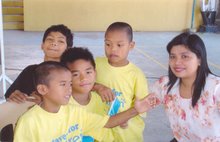
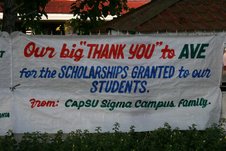
Aside from filing bills to upgrade the minimum salary grade level of public school teachers and providing them more benefits, AVE established, together with the Congressional Spouses Foundation, Inc., the “Haven for Children” along Zapote Road in Alabang, Muntinlupa City to provide temporary shelter and rehabilitation for homeless boys aged 6-13 in the Haven’s 9 two-story building complex.

“The objective of this endeavor is to prepare these youth toward formal education so that once they go to school, they will have the motivation to study,” explains the diminutive congressman whose organization supports 15,000 scholars nationwide. “In Manila, near the corner of San Marcelino and Ayala Blvd. in Ermita, we sponsor the “Gimme Shelter,” a center whose aim is to rehabilitate, assist in job placement, and relocation of the homeless, thus making them more productive citizens.”

The Gimme Shelter halfway house could accommodate five families at a time and stay for a maximum of five weeks, after which, they have to leave to give way to other homeless needing temporary shelter. Since its opening more than a year ago, it had sheltered 250 families, which were trained by the DSWD in livelihood projects.

Aside from the homeless and street children in need of temporary asylum, Magsaysay is also concerned with the well being of public school teachers.

“Any attempt for development will be futile without an educated work force,” avers the articulate solon that has more constituents than the majority of members of the Lower House who only represent their respective political district. “With a measly P9,939 salary per month, a public school teacher could barely make both ends meet for his or her family because according to the National Economic and Development Authority (NEDA), a monthly salary of P17,000 a month is needed to sustain a family of five.

“This is the reason why some teachers can’t even send their children to school. Worse, because of poor ventilation in poorly built classrooms that is crowded with up to 120 pupils, 2,376 public school teachers were reported to be afflicted with TB!” says Magsaysay, whose House Bill No. 1189 that aims to upgrade teachers’ salary is still being deliberated with the House’s Committee on Appropriations.

The proposed measure seeks to increase by P6,000 public school teachers’ monthly salaries, so that more qualified and competent educators will be attracted to teach in public schools, which are suffering from a shortage of 16,390 teachers.

With everything going in the right direction, Magsaysay is realizing his long-time dream—to push for a high quality Philippine education for the Filipino youth, which he believes will eventually cascade down to help ease the burden of his countrymen, for he believes that education is a potent tool in nation building.

“By joining the Alliance of Volunteer Educators, we gain broader chances of attaining our dreams and aspirations. As the old adage goes, `The whole is greater than the sum of its parts’,” concludes Magsaysay. “We can accomplish more if we join hands together. There is nothing more fulfilling than having contributed to affording our future generations a brighter horizon.”

‘Amang’ for automation

Party-list Alliance of Volunteer Educators Rep. Eulogio “Amang” Magsaysay calls for the “automation of the election process” ...to allow teachers to render voluntary, instead of mandatory, service during elections.”

Magsaysay recounts how 18 teachers on poll duty got caught in the “crossfire’ between political factions in a previous election and one Batangas teacher getting killed by gunmen trying to snatch the ballot box she was carrying.

High time Senate Bill 2231, as passed, became operational, Magsaysay believes, because teachers have had enough of political persecution and corruption during elections.

“We really have to do something about this recurrent plight of the public school teachers. Now, not tomorrow, not next week and, definitely, not beyond 2007,” Magsaysay said. The guy had a good teacher, for sure, in his time.

Solon backs poll automation to free nation’s teachers from mandatory service

A party-list solon is supporting the full automation of election process to free fellow teachers from election duties.

Rep. Eulogio “Amang” R. Magsaysay of the Alliance of Volunteer Educators (AVE) Party-list said that using an automated system in the election process will allow teachers to render voluntary and not mandatory service during elections.

“I believe that once we adopt an automated system in the conduct of the next elections, it will not be hard for us to take our teachers out of their election duties in the future,” he said following the passage of Senate Bill 2231 or the Automated Election System Act of 2006. With the use of automated machines, “we will need fewer teachers to man the polls and therefore, we can make it voluntary and no longer mandatory.”

The lawmaker expressed his concern on how teachers will still play major roles to safeguard the entire election process. Unlike the Armed Forces of the Philippines (AFP) that has recently been given limited participation during elections to prevent them from being used in election irregularities, teachers are yet to be freed from their full involvement.

“We have long been lobbying against the exploitation of teachers during elections,” the lawmaker said. He is co-authorship bills on making teachers render voluntary and not mandatory duties during elections such as House Bill 2864, “An Act to Help Improve the Quality of Education in the Country by Allowing Public School Teachers to Concentrate on their Teaching Duties.” The bill would amend Section 13 of Republic Act No.6646,’ The Election Reform Act of 198.”

Under HB 2864, instead of giving the membership of the Board of Election Inspectors solely to public teachers, citizens from civic, youth, professional, educational, business, labor, etc. shall be designated by COMELEC. This way, citizens, regardless of their professions, share equal burden of ensuring free, orderly elections, therefore, reducing the election duties of teachers.

House Bill 2898, “An Act Disengaging Public School Teachers from Compulsory Election Duties,” amends Section. 13 of R.A. 6646, to make it read as follows "Public school teachers who are willing to perform election duties shall be given preference in the appointment of members of the board."

Magsaysay cited many instances where the lives of teachers have been put in danger in doing their poll duties.

“Aside from the physical and mental fatigue our teachers have to endure during elections, they become subject of various forms of harassments from politicians and their supporters,” he said. “Unlike the military who have their guns and bullets to protect them against the perils of looking after the ballots, educators, teachers, in particular, only have chalk and blackboards since their main purpose is to teach. How do you expect them to defend themselves from such threats?”

Magsaysay, however, admitted that under the Omnibus Election Code, it is still the legal mandate of public school teachers to render service during elections. That is why according to him the government should study the possibility of making this service voluntary and not mandatory.

Magsaysay also pushed for the immediate release of their allowance. “As teachers, their salaries are not enough to support their daily living; that is why most of them have no choice but to really serve during elections.”

With the danger confronting teachers, government should give them additional insurance coverage aside from the security personnel provided to them every time they serve in election, the lawmaker added.

Re-take ng nursing exam, nararapat nga ba?

Antayin ang desisyon ng Court of Appeals.

Ito na ngayon ang pahayag ng Malakanyang sa gitna ng kontrobersiyang kinahaharap ng buong propesyon ng pagna-nars kaugnay ng naganap na leakage sa nursing licensure exam ngayong taon.

Matatandaang noong nakaraang linggo, matapos ngang makipagpulong ng Pangulo sa kanyang mga kabinete, nagpalabas ito ng kautusan na magkakaroon ng muling pagkuha ng eksaminasyon para sa mga kumuha noong Hunyo upang sagipin ang integridad ng propesyong naturan.

Kasama sa mga pinulong ng Presidente ay ang Professional Regulation Commission (PRC), Department of Labor and Employment (DoLE), at ang task force sa National Council On Licensure Examination (NCLEX). Ang DoLE ang siyang naatasan sanang magsabi sa publiko kung kelan ang gaganaping retake. Kasama naman ng ahensiyang ito ang PRC sa pagtalakay at pagdesisyon kung lahat ba ng kumuha ng eksamin ay pakukunin muli.

Pipirmahan din sana ni Arroyo ang Executive Order 565 na nagsasaad na ang PRC ay sasailalim na sa DoLE. Sa ilalim kasi ng Section 2 Chapter 1, title VII, Book III ng Executive 292, o ng Administrative Code of 1987, maaaring bigyan ng Pangulo ng kapangyarihan ang Kagawaran ng Paggawa upang lalo pang mapabuti ang sektor ng paggawa sa bansa.

Ngunit sa mga bagong kaganapan, at dahil na rin sa mga protesta ng karamihan, nagpalabas muli ng posisyon ang Pangulong Arroyo na aantayin muna nito ang resulta ng imbestigasyon ng National Bureau of Investigation (NBI) na nakatakdang isumite ng ahensiya sa Oktubre 15 bago tuluyang magbaba ng desisyon ukol sa kung magkakaroon nga ba ng retake o hindi. Kaalinsunod nito ay ang pag-aantabay sa magiging desisyon ng Court of Appeals (CA) kung ibabalewala ang resulta ng eksaminasyon noong Hunyo at kakanselahin ang lisensiya at panunumpang ginawa ng mga nakapasa. Ang napaulat ding E.O. ay sasailalim muna sa muling pag-aaral ng DOLE kung saan titingnan ng naturang ahensiya kung itutuloy nga ba ang pagkuhang muli sa test 3 at 5 ng mga mag-aaral sa nursing.

Isang matinding dagok nga ang naganap na leakage na ito hindi lamang sa propesyon ng pagna-nars, kundi sa buong bansang Pilipinas. Naapektuhan ang integridad hindi lamang ng industriya ng pagna-nurse kung hindi ang sistema ng edukasyon natin sa kasalukuyan.

Kung marami man ang nag-nanais na magkaroon muli ng pagkuha ng pagsusulit, marami rin ang pinipiling sa susunod na lamang kumuha ng eksaminasyon upang huwag ng masama pa sa grupo ng mga nabahiran ng pagdududa. Ang iba naman ay nagrereklamo dahil na rin ang iba sa kanila ay nasa ibang bansa na at nagtratrabaho roon matapos magkaroon ng oath taking noong Agosto.

Para sa Alliance of Volunteer Educators (AVE) Party-list, sa pangunguna ni Cong. Eulogio “Amang” R. Magsaysay, hindi sapat ang pagkakaroon ng re-take sa mga eksaminasyon upang tuluyang malinis ang pangalan ng buong propesyon. Oo nga’t maaaring mapatunayan ng mga nakapasa noong Hunyo na talagang karapat-dapat silang maging nars kapag naipasa nilang muli ang pagkuha ng board exam. Subalit dapat tiyakin natin, higit sa lahat, na hindi basta-basta makalulusot ang mga tao sa likod ng naturang pandaraya. Nararapat lamang na ituloy ang imbestigasyon upang mabatid natin ang puno’t dulo ng lahat ng ito at maparusahan ang mga dapat maparusahan.

Nananalig si Cong. Amang Magsaysay na ating malalampasan ang kontrobersiyang ito at tuluyan na tayong makakabangon sa hagupit ng nursing examination leakage tulad ng pagnanais nitong makayanan ng ating mga kababayang nasalanta ng bagyong Milenyo na makabangon at makapamagong buhay muli.